
Chemical & Heavy-Metal Disinfection
Mercury, lead, and chemical residue removal with surface testing and clearance.
Learn more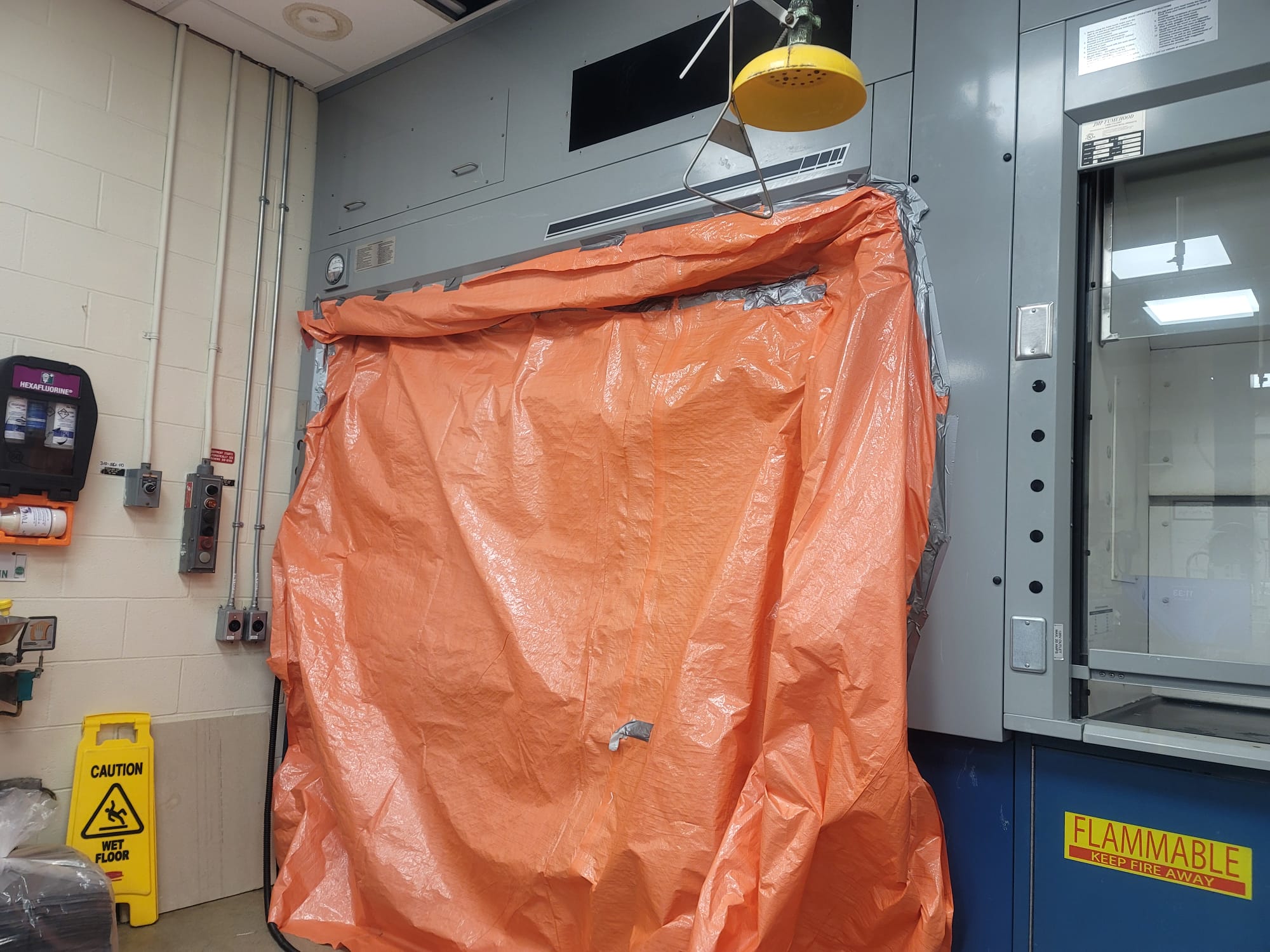
Old perchloric acid hoods can build shock-explosive crystals deep inside the ductwork. We test for them, wash them out, neutralize what is left, and hand you a clearance report before anyone touches the hood for removal.
Here is the part that scares people, and it should. Perchloric acid vapor travels up the duct, cools, and leaves behind dry crystals. Those crystals are shock-sensitive and can explode if a saw or a wrench hits them. More than one demolition crew has learned that the hard way.
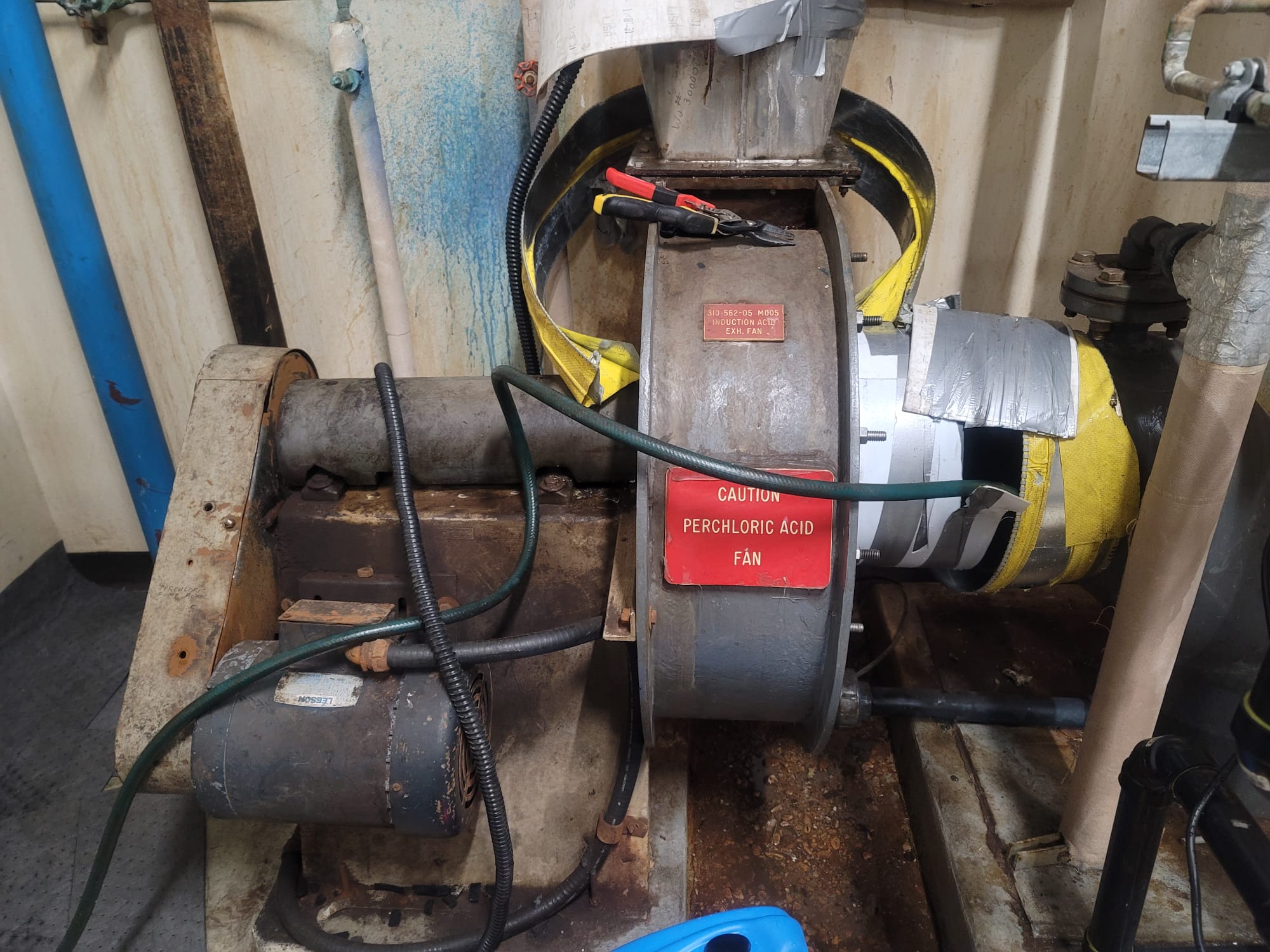
Perchloric acid decontamination is the careful process of finding those deposits, washing them out, and neutralizing them so the hood and its ductwork are safe to service, move, or tear down. This is not a job for a general contractor. It needs testing, the right wash-down method, and paperwork at the end.
We inspect the hood, ducts, and any wash-down parts and test surfaces for perchlorate crystals. This tells us how far the problem goes before anyone touches anything.
Perchlorate is water-soluble, so the proven method is a controlled wash-down of the hood and a long flush of the ductwork with large volumes of water. We contain the runoff and handle it as regulated waste.
We neutralize what we find and test again to confirm the surfaces are clear. We do not call it done on the first pass, we prove it.
You get a written clearance report so your demolition or moving crew can work safely, and so your safety office has a record.
Once a perchloric hood is cleared, decommissioning is straightforward. If you are removing the hood, our laboratory decommissioning team can isolate and dismantle the ductwork, and our air balancing crew can rebalance the room afterward so the remaining hoods still contain.
We test surfaces in the hood and ductwork for perchlorate. Signs like a wash-down system, a perchloric label, or a history of acid digestion work raise the odds, but testing is the only way to be sure. We always test before anyone opens the ducts.
When perchloric acid vapor dries in ductwork, it can form crystals that are shock-sensitive and flammable. A small impact from a tool during removal can set them off. That is why decontamination has to happen before any cutting or dismantling.
It depends on the size of the system and how much residue we find. A wash-down and duct flush can run over a day or more, because the flush needs enough water and time to be thorough. We give you a timeline after the first test.
Yes. Every job ends with a written clearance report and, where it applies, waste manifests. That record lets your demolition crew work safely and gives your safety office and insurer proof the hood was handled correctly.
Describe what is in your lab and we will tell you what testing or cleanup makes sense, with no obligation.
Book a Site Assessment